
The Most Common Misdiagnosis in Natural Hair Care
The natural hair community has a tendency to present moisture as the universal answer. Dry hair? More moisture. Breakage? More moisture. Limp, soft, mushy hair that stretches too far and feels like it has no structure? More moisture.
That last one will make things significantly worse.
The protein-moisture balance is one of the most important concepts in hair care and one of the most consistently misunderstood. Understanding it requires understanding what hair is made of and what keeps it structurally intact.
Porosity
How thirsty is your hair?
Low porosity
Cuticles lie tight and flat. Water beads and rolls off; products sit on top. Needs warmth and humectants to let moisture in.
Medium porosity
Cuticles sit slightly open. Accepts and holds moisture well — the easiest balance to keep.
High porosity
Cuticles lift and gap — often from heat, colour, or genetics. Drinks moisture fast and loses it just as fast. Loves a sealing oil and protein.
Porosity is how easily the cuticle lets water in and out. The float test tells you yours — and it decides whether your hair needs more moisture, more sealing, or more protein.
Hair Structure: The Quick Version
The hair shaft is approximately 95% keratin — a fibrous structural protein composed of amino acid chains held together by disulfide bonds, hydrogen bonds, and ionic bonds. These bonds are what give hair its tensile strength and elasticity: the ability to stretch under tension and return to its original length.
The cortex — the middle layer of the shaft — is where most of this protein structure lives. Surrounding it is the cuticle: overlapping scale-like cells made of a harder form of keratin that protect the cortex and regulate what enters and exits the shaft.
Water molecules interact with hair primarily through the hydrogen bonds in the protein structure. When hair absorbs water, these bonds relax, the shaft swells, and the hair becomes more pliable. When it dries, hydrogen bonds reform and the hair returns to its resting state. Healthy hair moves through this cycle without losing integrity.
Under the microscope
Closer still
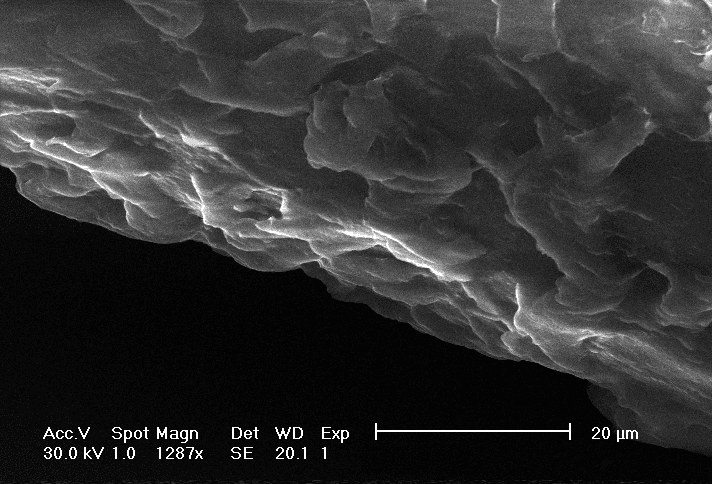
At higher magnification the cuticle's rough, tiled surface emerges. It lies smooth when the hair is moisturised and sealed, and lifts when it is dry or damaged — which is when breakage begins.
SEM: Foreade · CC BY-SA 4.0 · Wikimedia Commons
The Wet Stretch Test
Take a single strand of your hair when it is saturated with water — after washing, in the shower. Hold it at the root between two fingers and the tip between the other hand. Gently stretch it.
What does it do?
Scenario A
The strand stretches easily, maybe 30–50% of its length, then gently springs back. This is the correct response. Protein-moisture balance is good.
Scenario B
The strand stretches very easily — 50% or more — feels almost rubbery or gummy, and does not spring back well. It may feel mushy or lack any sense of structure when wet. This is hygral fatigue or moisture overload. You have too many moisture treatments and not enough protein. The hydrogen bonds that should be reforming when the hair dries are not doing so efficiently because the protein scaffold they attach to has been overwhelmed by water.
Scenario C
The strand snaps immediately or after very little stretch — barely 10% — without giving. There is no elastic recovery; it just breaks. This is protein deficiency or protein overload (paradoxically, too much protein with no moisture creates rigidity that snaps rather than bends). If the hair also feels very hard and straw-like, it is likely protein overload. If it feels brittle and fragile rather than hard, protein deficiency is more likely.
The distinction between protein deficiency and protein overload in Scenario C is important: treating protein overload with more protein will make things worse. The immediate intervention for protein overload is a deep moisture treatment and temporarily stopping all protein treatments.

The Porosity Test
The float test gives you information about porosity that helps contextualise your protein-moisture balance:
Take a clean strand (no product on it) and drop it into a glass of room-temperature water. Observe for 2–3 minutes.
Floats near the top
Low porosity. The cuticle is tightly closed; water penetrates slowly. Low porosity hair is more prone to moisture overload because once the water gets in, it is also slow to leave.
Sinks gradually
Medium porosity. Normal cuticle behaviour. This hair type usually responds well to a balanced routine.
Sinks quickly
High porosity. The cuticle is raised — either from chemical damage, heat damage, or genetics. High porosity hair absorbs water rapidly but loses it just as fast. Protein helps fill the gaps in the cuticle and slow moisture loss.
Porosity
How thirsty is your hair?
Low porosity
Cuticles lie tight and flat. Water beads and rolls off; products sit on top. Needs warmth and humectants to let moisture in.
Medium porosity
Cuticles sit slightly open. Accepts and holds moisture well — the easiest balance to keep.
High porosity
Cuticles lift and gap — often from heat, colour, or genetics. Drinks moisture fast and loses it just as fast. Loves a sealing oil and protein.
Porosity is how easily the cuticle lets water in and out. The float test tells you yours — and it decides whether your hair needs more moisture, more sealing, or more protein.
Correcting Moisture Overload
If your wet stretch test showed Scenario B:
Reduce moisture treatment frequency. If you are deep conditioning every wash day, move to every other wash day. If you are co-washing daily or every other day, reduce frequency.
Introduce a light protein treatment. A rinse-out protein treatment (not a hard protein like keratin) once or twice a month will begin to rebuild the bond structure. Fenugreek is an excellent mild protein source — its high content of phytoproteins and galactomannan provides conditioning protein without the rigidity risk of harder proteins.
The Sanyu Balm provides balanced protein. The hydrolysed proteins in the balm's formulation are small enough to penetrate the cuticle rather than sitting on the shaft surface, providing internal protein reinforcement. Using the balm as your sealant step means each application contributes to the protein-moisture balance without requiring a separate treatment.
Under the microscope
The cuticle's overlapping scales
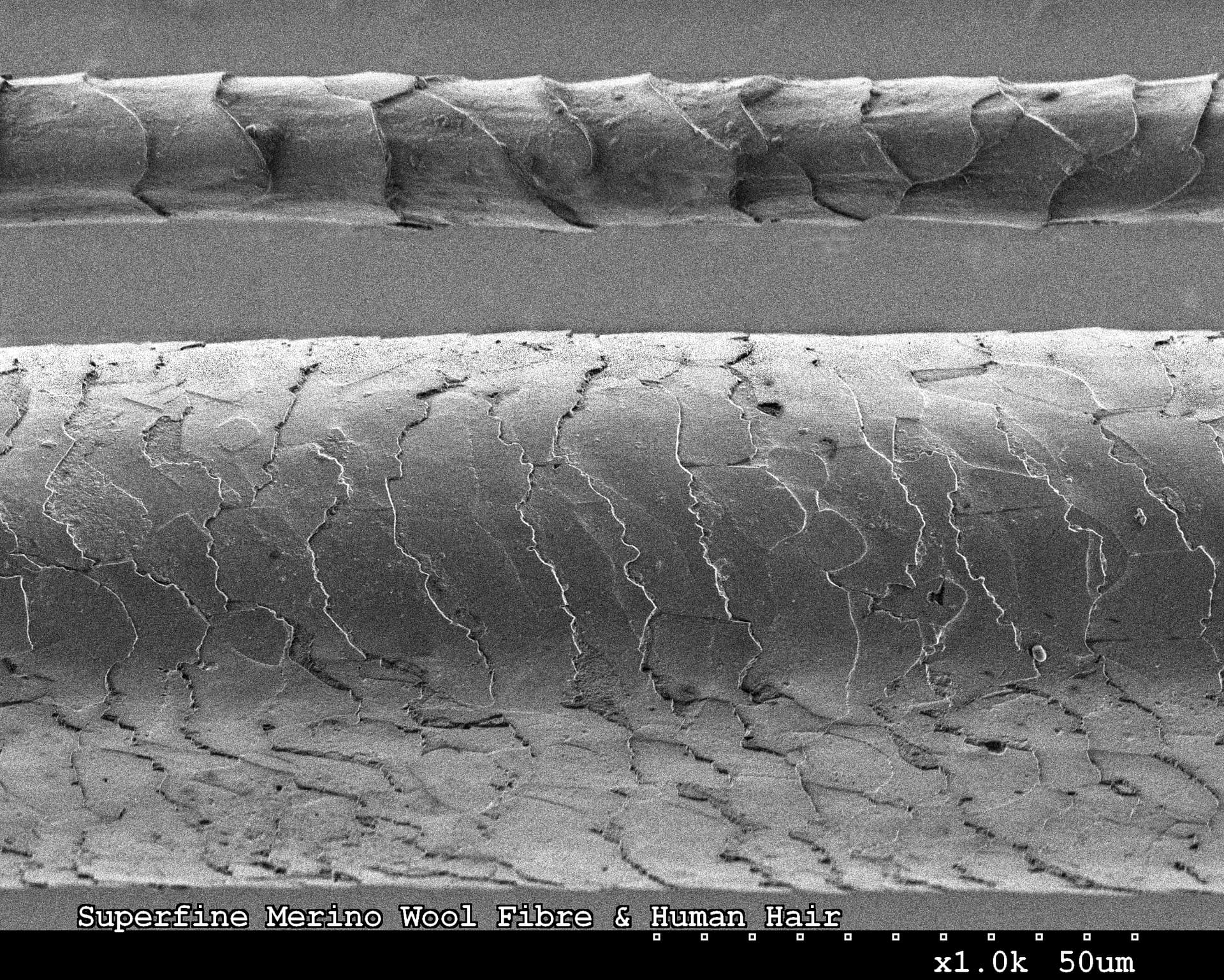
Human hair (below) shares the tiled, overlapping-scale architecture of wool (above). Sealed flat, these scales trap moisture in; lifted, they let it escape.
SEM: CSIRO · CC BY 3.0
Correcting Protein Deficiency
If your wet stretch test showed Scenario C (brittle, snaps, fragile):
Assess your current product routine for protein content. If you are using a routine with no protein-containing products, this is your answer.
Introduce protein consistently. A rice water rinse (fermented or plain, 20 minutes as a pre-treatment) provides hydrolysed rice protein that coats and temporarily reinforces the cuticle. An egg treatment (yolk only) applied for 20 minutes provides high-quality protein directly to the shaft. These are traditional treatments with biochemical validity.
The fenugreek infusion in the Signature Oil contributes directly here. Fenugreek seeds contain saponins and trigonelline alongside their protein content, and their topical application has been associated with reduced hair shedding in studies measuring traction and breakage. The oil application deposits a protein-containing coating on the shaft with each use.
The Balance
There is no formula for the correct protein-moisture ratio because every woman's hair is different — different porosity, different damage history, different climate, different product routine. The wet stretch test is not a one-time diagnostic. It is something you do regularly, ideally every wash day, until you develop an intuitive sense of what your hair is telling you.
Hair communicates clearly. The discipline is learning its language.