Nobody Tells You About the Demarcation Line
The internet is full of transitioning success stories: dramatic before-and-after photographs, women with thick, defined coils, gleaming in natural-light photography. What you see less of is months 4 through 8: the part where the demarcation line is doing everything it can to make you pick up the relaxer kit again.
The demarcation line is the point on each strand where the relaxed hair ends and the new natural growth begins. At this junction, two completely different hair structures meet. Your relaxed ends have been chemically altered — the disulfide bonds in the cortex have been broken and reformed in a straightened configuration. Your new growth is in its original structure: tightly coiled, with fully intact disulfide bonds. The difference in elasticity and porosity between these two sections is significant.
At the line, the strand has to accommodate the tension of two structures behaving differently every time it is wet, dried, stretched, or manipulated. This is where most transitioning hair breaks. Not at the damaged ends. Not at the new growth. At the line.
Texture
The Type 4 family
4A
Springy coils
Tight, springy S-shaped coils with a visible curl pattern. Holds moisture best of the three.
Shrinkage ~30%
4B
Sharp Z-bends
Bends in sharp angles rather than curling. Densely packed, fluffy, less defined.
Shrinkage ~50%
4C
Tightest coil
The tightest pattern, often with no defined curl until defined. Maximum volume — and maximum shrinkage.
Shrinkage up to 75%
Shrinkage is not lost length — it is the coil doing exactly what it should. The tighter the pattern, the more it springs back. We measure length stretched, and celebrate the spring.
The Chemistry of the Break
Relaxed hair has a higher porosity than natural hair — the chemical processing raised and disrupted the cuticle permanently. It swells more rapidly when wet and loses moisture more quickly when dry. Natural new growth, with its intact cuticle, behaves differently: it swells uniformly and retains moisture more effectively.
When you wet transitioning hair, the new growth and the relaxed section absorb water at different rates. The new growth expands in a tight coil. The relaxed section elongates. At the demarcation line, these two movements pull in opposite directions. Repeated wet-dry cycles concentrate mechanical stress at the junction. This is why transitioning hair feels like it snaps at the most inconvenient point — not the tip, not the root, but the line.
If you have also been over-using protein treatments in an attempt to strengthen the hair, you may experience protein overload at the demarcation line specifically. Protein binds to the raised cuticle of the relaxed section readily but has less effect on the intact cuticle of natural growth. An uneven protein distribution creates brittleness at the line rather than strength.
Under the microscope
Closer still
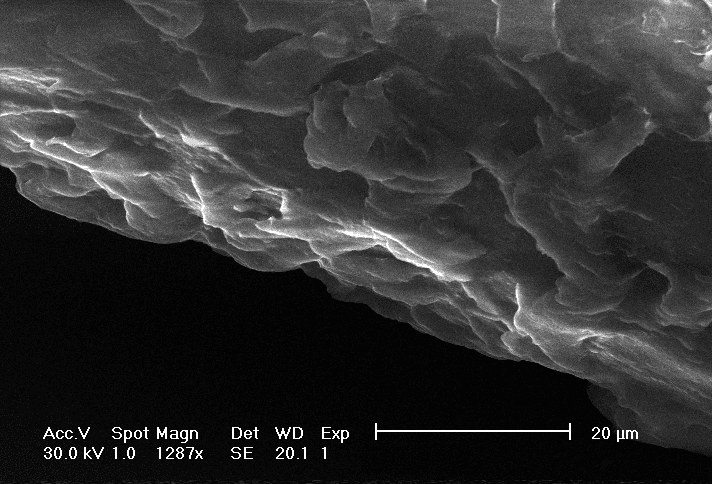
At higher magnification the cuticle's rough, tiled surface emerges. It lies smooth when the hair is moisturised and sealed, and lifts when it is dry or damaged — which is when breakage begins.
SEM: Foreade · CC BY-SA 4.0 · Wikimedia Commons
The 12–18 Month Reality
A healthy scalp grows approximately 1.25cm of hair per month. If your goal is to transition without cutting off the relaxed ends — a "grow-out" — you need 12–18 months of new growth before most of your length is natural. For many women, this means managing two textures for over a year.
This is genuinely difficult. There is no kind way to say it. You will have days when your hair feels like it is working against you. You will have days when the new growth and the relaxed ends refuse to cooperate in the same style. This is not a sign that your natural hair is unmanageable. It is a sign that you are mid-process.
The women who succeed at transitioning are not the ones with the best hair. They are the ones with the clearest understanding of what is actually happening and the most consistent application of protective strategies.

Protective Strategies at the Line
Moisture priority
The demarcation line needs constant hydration. Dryness at the line equals breakage at the line. Your LCO (Liquid-Cream-Oil) routine should focus product application at the line specifically, not just the tips.
Protein balance
Do a monthly protein treatment on the relaxed section only, keeping it away from the new growth. The relaxed hair needs protein to temporarily fill gaps in its damaged cuticle. The natural hair does not need protein at the same frequency and can become protein-overloaded if treated the same way.
Low manipulation
Every time you manipulate transitioning hair, you create friction at the demarcation line. Protective styles — twists, braids, buns, Bantu knots — reduce daily manipulation and keep the line stable. Style with your hands rather than combs wherever possible.
Detangle carefully
Detangle in sections, starting from the tip and working upward. Use a wide-tooth comb only on fully saturated, conditioned hair. The demarcation line is the most vulnerable point — never force a comb through it.
Texture
The Type 4 family
4A
Springy coils
Tight, springy S-shaped coils with a visible curl pattern. Holds moisture best of the three.
Shrinkage ~30%
4B
Sharp Z-bends
Bends in sharp angles rather than curling. Densely packed, fluffy, less defined.
Shrinkage ~50%
4C
Tightest coil
The tightest pattern, often with no defined curl until defined. Maximum volume — and maximum shrinkage.
Shrinkage up to 75%
Shrinkage is not lost length — it is the coil doing exactly what it should. The tighter the pattern, the more it springs back. We measure length stretched, and celebrate the spring.
The Chebe Balm for Transitioning Hair
The chebe compound in the Sanyu Balm is particularly useful for transitioning hair for a specific reason: its resinous compounds create a semi-occlusive coating on the hair shaft that reduces the differential swelling between natural and relaxed sections during wetting.
By coating the entire strand — from new growth through the line to the relaxed tip — with the balm before washing, you reduce the rate of water uptake across both sections. The new growth and the relaxed ends still behave differently, but the difference is moderated. The mechanical stress at the demarcation line is reduced.
Use the balm as your pre-poo treatment every wash day: section by section, root to tip, at minimum 30 minutes before washing. On non-wash days, apply a small amount through the mid-lengths, focusing on the line, to maintain the coating and prevent the micro-dryness that precedes breakage.
Under the microscope
The cuticle's overlapping scales
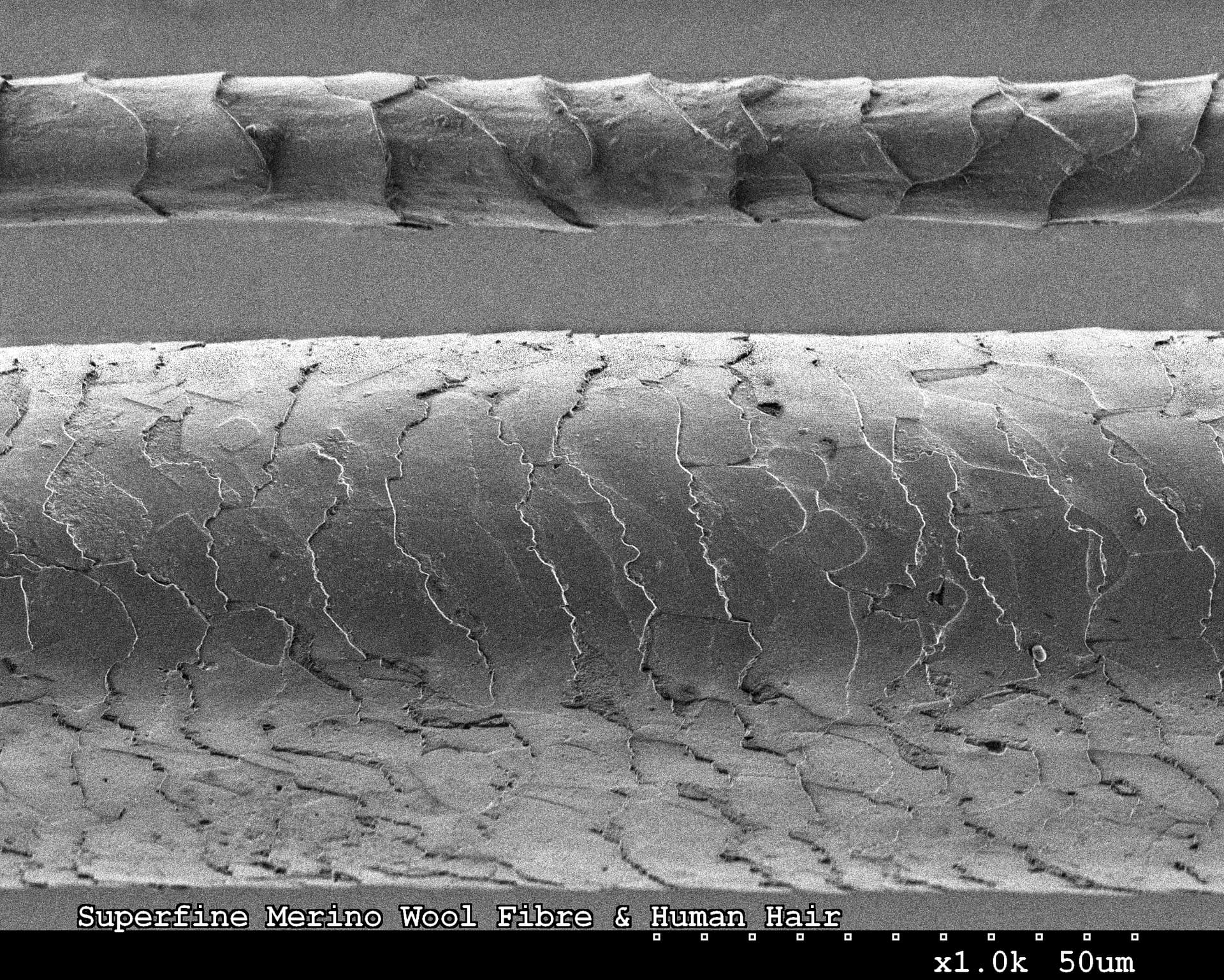
Human hair (below) shares the tiled, overlapping-scale architecture of wool (above). Sealed flat, these scales trap moisture in; lifted, they let it escape.
SEM: CSIRO · CC BY 3.0
Protective Styles and Time
Protective styling during transition is not about hiding your hair. It is about reducing manipulation during a period when your hair cannot afford extra mechanical stress. Box braids, two-strand twists, crochet styles, and Bantu knots all keep the demarcation line bundled, reduce friction, and allow you to focus on scalp health rather than daily hair management.
Two rules for transitioning protective styles: no style should be tight (tension at the hairline is the last thing transitioning hair needs), and no style should stay in for more than 6–8 weeks. Hair left in a protective style too long mats at the roots as shed hairs accumulate, and the subsequent detangling session undoes weeks of careful protection in one brutal hour.
The Big Chop Consideration
The big chop — cutting off all the relaxed ends at once — is not giving up. For many women, it is the more honest path. It removes the demarcation line entirely, eliminates the breakage risk, and allows you to start your natural hair journey working with one texture from day one.
The decision is personal, not chemical. If the idea of short hair is genuinely distressing, the grow-out is a valid path — with the strategies above, it is manageable. But if you are finding the grow-out process disheartening and the demarcation line is causing consistent breakage, the big chop may be the act of radical honesty that your hair requires.
Either way: you are not starting over. You are starting correctly.