The Hair That Stayed Through Pregnancy
Many women notice, during pregnancy, that their hair is fuller, thicker, more abundant than it has ever been. They shed less. Their ponytail feels heavier. This is not imagination.
During pregnancy, elevated levels of oestrogen prolong the anagen phase of the hair growth cycle — the active growth phase. Normally, a follicle cycles through anagen (growth, lasting 2–7 years), catagen (transition, lasting 2–3 weeks), and telogen (resting, lasting approximately 3 months) before the hair sheds and regrowth begins. Oestrogen extends anagen and delays the entry of hairs into telogen. The result: more hairs are in the growth phase simultaneously, and fewer shed at any given time.
This is why pregnancy hair looks so good. You are keeping hairs that would ordinarily have shed.

The Drop
After delivery, oestrogen levels fall precipitously. This is normal and necessary — the body is recalibrating from the hormonal environment of pregnancy. But the hair follicles, which had been held in extended anagen by high oestrogen, now respond to the hormonal drop by entering telogen en masse.
Three months later — because the telogen phase lasts approximately 90 days before the hair sheds — those follicles all release simultaneously.
“This is telogen effluvium. It is not hair loss in the pathological sense. It is a synchronised shedding event: the catch-up on months of delayed shedding, all at once.”
The timing is precise enough that you can almost count from it. Birth at month zero. The shed begins at months 3–4. Peak shedding is typically months 4–6. Resolution begins months 6–9. By month 12 postpartum, most women are back to their pre-pregnancy density.
Most. Not all. Which matters.
DHT and the Postpartum Window
There is a secondary mechanism that makes the postpartum period particularly vulnerable for women with genetic susceptibility to androgenic hair thinning.
As oestrogen falls after delivery, the ratio of androgens to oestrogens shifts dramatically. Dihydrotestosterone (DHT) — the androgen responsible for follicle miniaturisation in androgenic alopecia — was effectively suppressed during pregnancy by high oestrogen. After delivery, DHT activity rebounds.
For women with follicles that are sensitive to DHT (genetically determined, more common than most people realise), the postpartum window is the first or an accelerated expression of androgenic thinning. The hairline recedes slightly. The temples thin. The crown becomes more visible. This is distinct from telogen effluvium and does not fully resolve on the 12-month timeline.
Knowing which kind of shedding you are experiencing matters. If your hair is recovering broadly — thickening again across the whole scalp — the telogen effluvium resolution is underway. If thinning is concentrated at the hairline, temples, and crown and is not recovering after 12 months, a conversation with a dermatologist or trichologist is warranted.
Under the microscope
The cuticle's overlapping scales
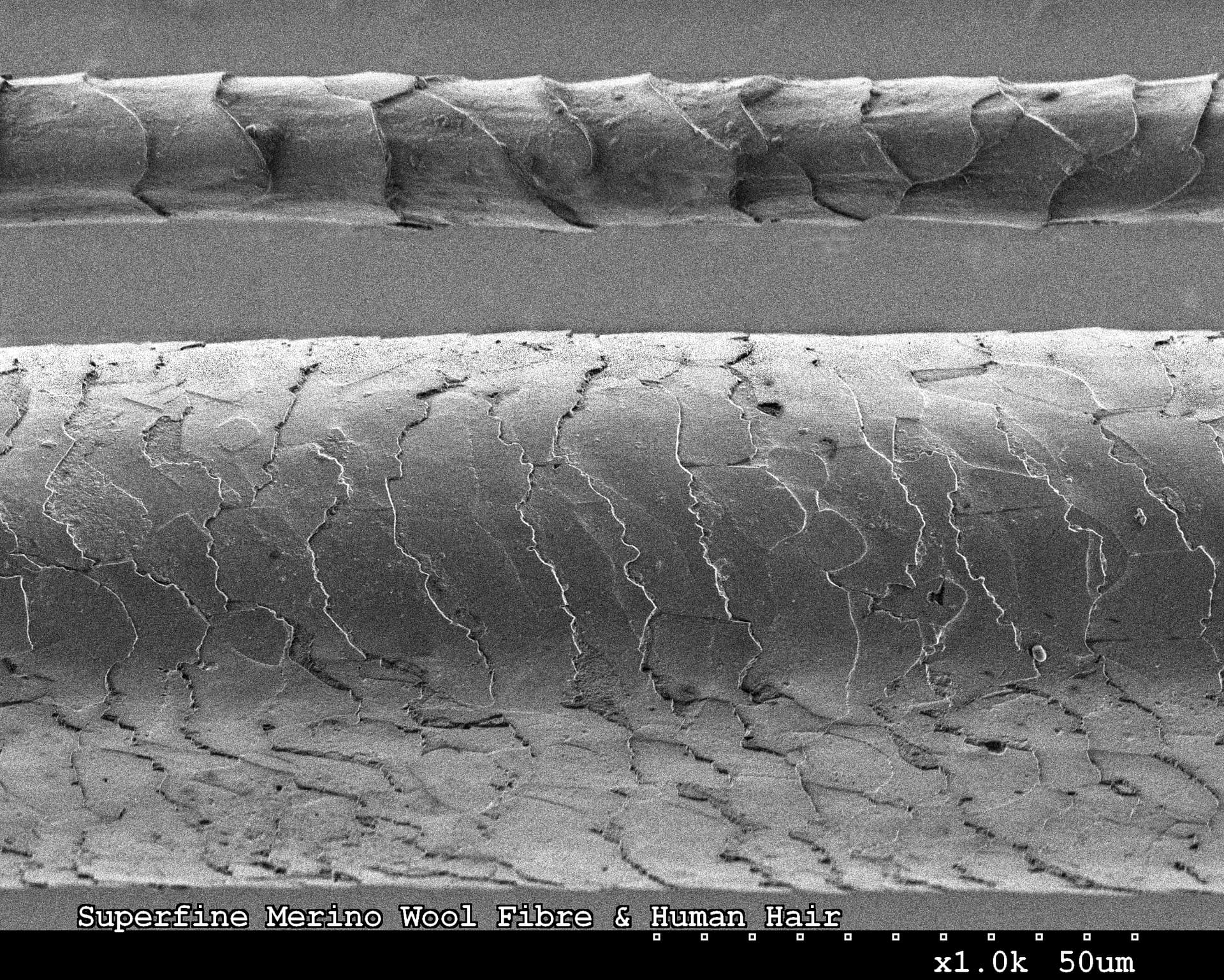
Human hair (below) shares the tiled, overlapping-scale architecture of wool (above). Sealed flat, these scales trap moisture in; lifted, they let it escape.
SEM: CSIRO · CC BY 3.0
The Emotional Weight
The medical literature on postpartum telogen effluvium is careful about timelines and mechanisms. It is considerably less careful about the emotional reality.
You have just had a baby. You are sleep-deprived, hormonally turbulent, and physically depleted. And now your hair — which felt extraordinary throughout pregnancy — is coming out in the brush, on the shower floor, on the pillow. Handfuls of it.
This is not the time at which most women can hear "it's temporary" and feel reassured. The hair that is falling out represents something: a version of yourself that felt intact, that felt beautiful, that felt in control of something. Losing it, even temporarily, is a genuine grief.
The most important thing to understand is this: the follicles are not dead. Telogen effluvium is a shedding of hairs, not follicles. The follicles that shed those hairs are dormant, not destroyed. They will cycle back into anagen. They will produce new hair. This is not the beginning of permanent hair loss. It is a biological event with a known endpoint.
What the Science Supports
Nigella sativa (black cumin)
The thymoquinone in black cumin has been shown in multiple studies to inhibit 5-alpha reductase — the enzyme that converts testosterone to DHT. This addresses the androgenic component of postpartum shedding. It will not stop telogen effluvium (which is not DHT-driven), but it may reduce the degree to which the postpartum DHT rebound affects sensitive follicles.
Rosemary
A randomised controlled trial (Panahi et al., 2015; Investig Dermatol) comparing rosemary oil to 2% minoxidil found equivalent hair count improvements at 6 months. The mechanism is twofold: carnosic acid supports nerve growth factor in follicles, and rosemary stimulates microcirculation in the scalp dermis, improving nutrient delivery to recovering follicles. The Sanyu Signature Oil includes rosemary in its cold infusion.
Scalp massage
A standardised scalp massage protocol (4 minutes daily, 9 N pressure) demonstrated increased hair thickness in a Japanese study (Koyama et al., 2016; Eplasty). The mechanism is mechanical: compression and release of dermal tissue stimulates growth factor expression and blood flow. For a postpartum mother, this is a 4-minute daily act of self-care that has measurable biological support.
Protein
The postpartum body is nutritionally depleted. Hair is protein. Ensure adequate dietary protein (minimum 1.2–1.6g per kg of body weight daily while breastfeeding) and apply protein topically. The fenugreek seed in the Sanyu oil infusion contains phytoproteins and saponins that help maintain hair shaft integrity during periods of increased shedding.
The Sanyu Oil application protocol during postpartum recovery
Apply 4–6 drops to the scalp nightly for the first 8 weeks, focusing on the hairline and crown. Follow with 2–3 drops through the mid-lengths. The anti-inflammatory action of thymoquinone, the circulation-stimulating action of rosemary, and the scalp-protective properties of castor combine into a daily intervention that addresses both the follicle environment and the hair shaft integrity simultaneously.
A Timeline for Reassurance
Months 1–3 postpartum: Hair may seem fine. Enjoy it. Months 3–6: Peak shedding. This is expected. Document your density with a photograph now so you have a baseline. Months 6–9: Shedding slows. Baby hairs begin appearing at the hairline — short, fine, upright new growth. These are your follicles waking up. Months 9–12: New growth is visible and unmistakable. Density returning. Month 12+: Assessment point. If you are not seeing recovery, seek professional evaluation.
You are not losing your hair. You are lending it, and it is coming back.